What is crystalline glaze pottery?
The patterns on a crystalline vase are not painted on. They are real crystals that grow inside a molten ceramic glaze as chemistry, heat, and time meet in the kiln.
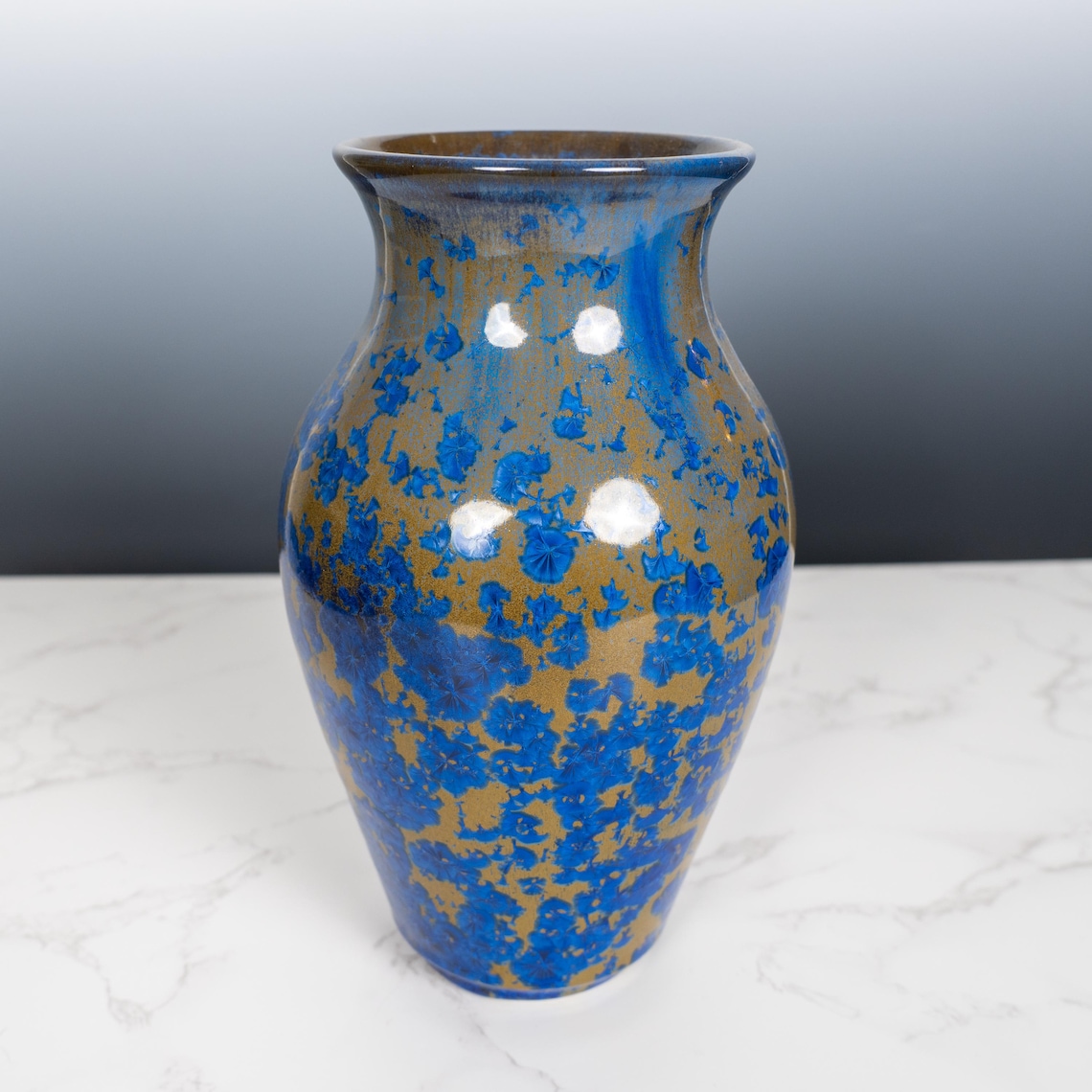
Crystalline pottery uses a glaze designed to grow crystals large enough to become the surface pattern.
Zinc and silica provide the ingredients for crystal growth, while the rest of the glaze controls melt, color, and background.
The glaze melts, then passes through a controlled crystal-growing range. Time and temperature influence the field that develops.
Each form, glaze application, kiln position, and firing is slightly different. The result cannot be reproduced like a printed motif.
Seven vessels, seven different crystal fields.
These newly photographed forms show how cobalt, celadon, cream, gold, and crackle shift across different shoulders, necks, and silhouettes.

Cobalt Blue Bottle
A tall closed form with a narrow neck and a deep blue surface that shifts through smoky violet and fine crystalline detail.

Blue and Gold Asymmetrical Bottle
A gently curved tip extends the silhouette above a dark crackled field of blue crystals edged in warm gold.

Pale Blue Crystalline Vase
A tall wheel-thrown vase with a softly flared rim and layered pale blue crystals opening across a cream ground.

Celadon Crystalline Vase
A rounded vessel covered in soft blue crystal clusters, with a warm dark rim that defines the opening.

Blue and Gold Bulbous Bottle
A full-bodied bottle with a long flared neck and a varied field of cobalt crystals, gold edges, and darker movement near the foot.

Tall Cobalt Crystalline Bottle
A slender closed form whose cobalt crystal clusters gather densely toward the shoulder and soften toward the base.

Cobalt Crackle Vase
A compact vase with bold blue crystalline pools suspended in a fine pale crackle network.
How a crystalline surface develops.
In broad terms, a macrocrystalline glaze is a glass that has been persuaded to crystallize. Zinc oxide and silica can form zinc-silicate crystals—often willemite—inside the glaze layer. The goal is not simply to reach a peak temperature, but to give those crystals a useful environment in which to begin and grow.
Build a form for movement
The vessel is thrown or built first. Curves, shoulders, and changes in angle matter because a molten glaze moves differently across each part of the form.
Apply a crystal-forming glaze
A macrocrystalline glaze is formulated so zinc and silica can come together as visible crystals. Colorants help shape the crystal color and the surrounding glassy ground.
Melt, cool, and give crystals time
The glaze first becomes fluid. As the kiln moves through a favorable temperature range, tiny nuclei can develop into crystals large enough to see. The exact schedule depends on the glaze, clay, form, and kiln.
Inspect and finish the vessel
Crystalline glazes can flow significantly, so the firing and cleanup require planning. Afterward, the surface and foot are inspected and finished for the particular piece.
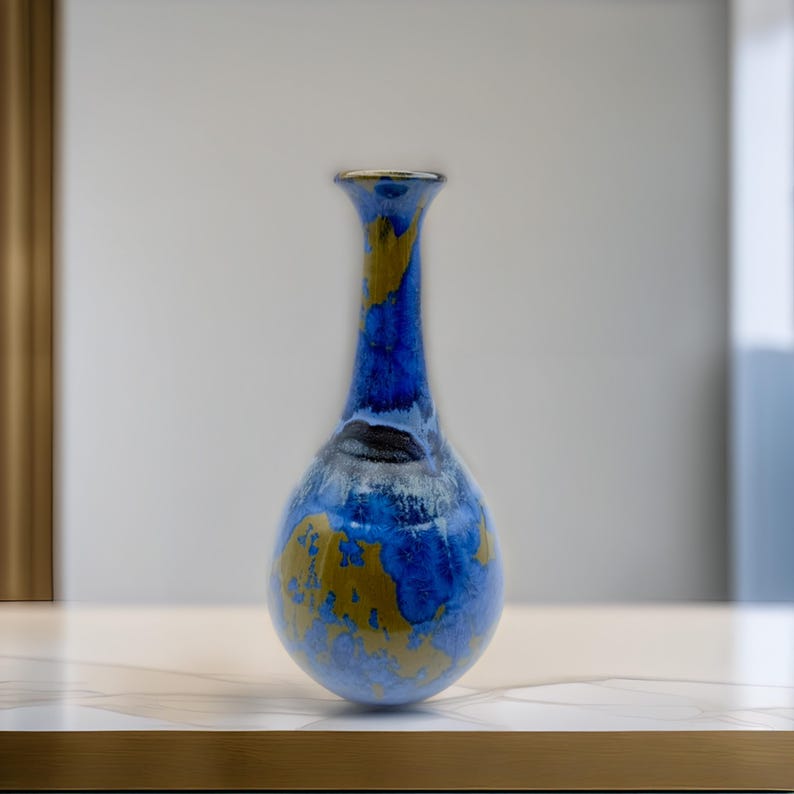
Control sets the stage. The kiln writes the pattern.
My crystalline work has developed through repeated tests and the close reading of fired surfaces. I can choose the form, glaze family, color direction, application, and firing approach. I cannot place every crystal. That balance—careful preparation followed by genuine material variation—is the reason I keep returning to the process.
A successful piece records both intention and the conditions of one firing. Even related vessels remain individual objects, with their own concentrations, open spaces, overlaps, and changes in color.
View the exact pieces currently available →Formula, firing, and finish have to work together.
There is no universal recipe or schedule that behaves the same in every studio. A useful crystalline result depends on the complete system: glaze chemistry, clay, form, application, kiln, and the way the fired piece is finished.
Enough structure, enough movement.
The glaze must melt fluidly enough for materials to move, while still supporting nucleation and crystal growth. Small chemistry changes can affect the number, size, shape, and color of the crystals.
A growth window, not a single moment.
After the glaze melts, controlled cooling or holds can keep it in a range where crystals develop. The useful range and timing belong to the particular glaze-and-kiln combination.
Plan for a glaze that wants to run.
Macrocrystalline glazes can be very fluid. Studio practice must account for that movement, protect the kiln, and leave a clean, carefully inspected foot after firing.
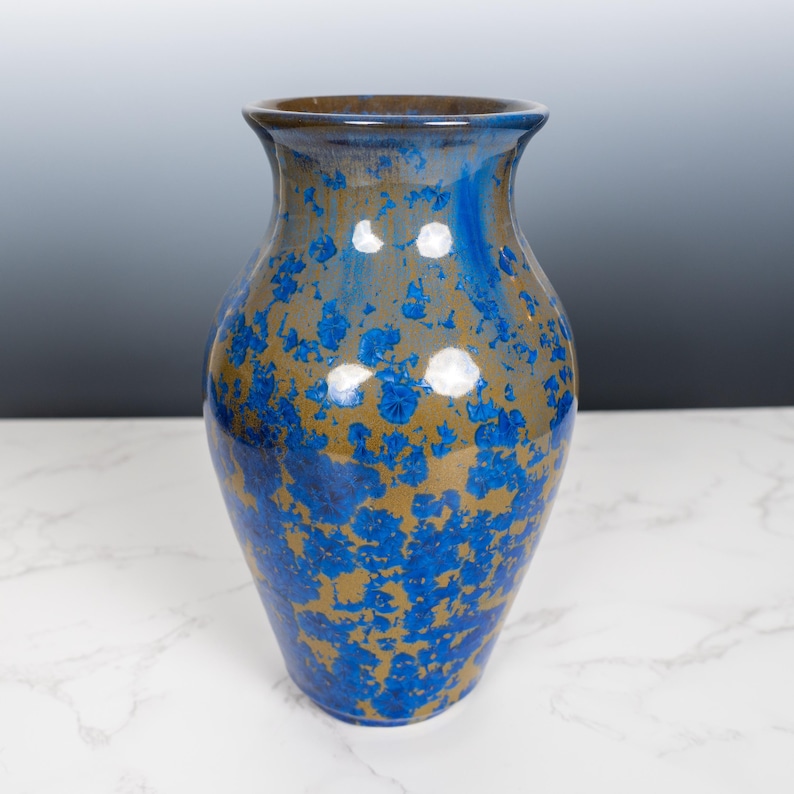
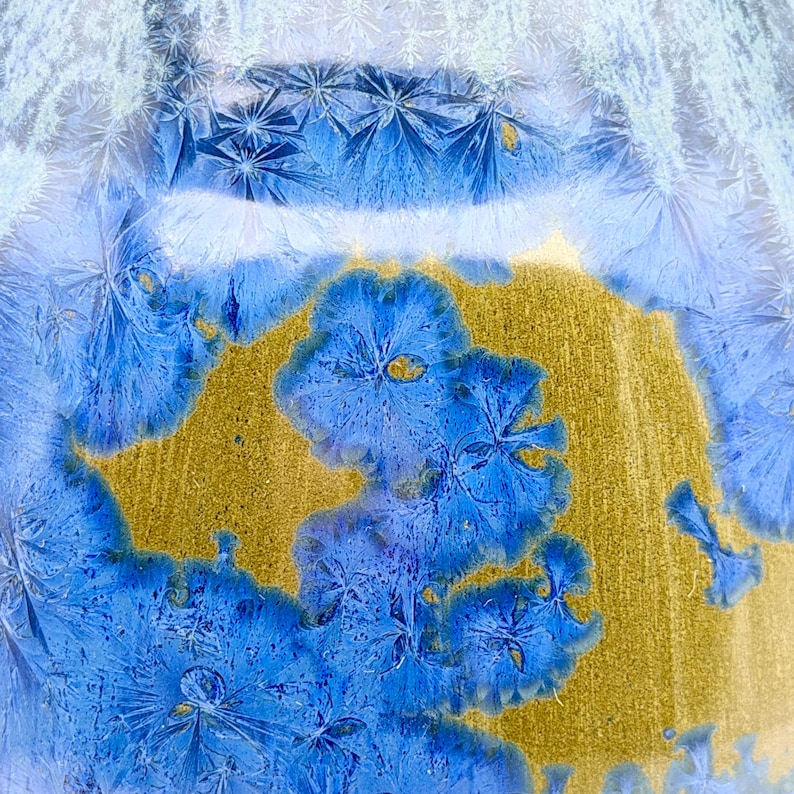
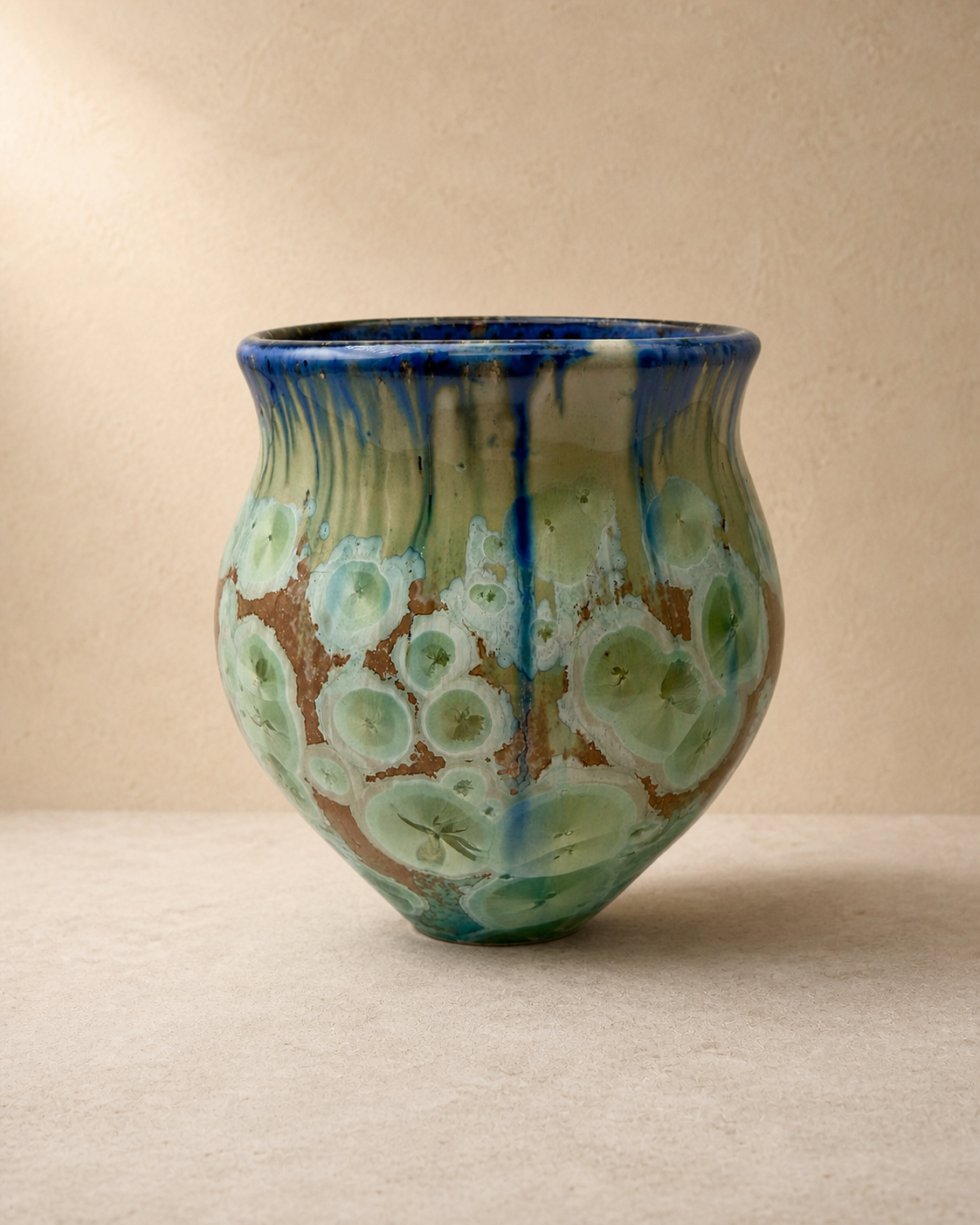
Color is part chemistry, part atmosphere.
Coloring oxides can affect the crystals, the surrounding glaze, or both. Cobalt is associated with much of the blue work shown here; nickel can produce a different range of responses. The result is not a colored drawing of a crystal. It is a colored glassy surface in which crystals have actually grown.
One nickel-rich experiment continued after the kiln. I recorded how a selective acid treatment shifted teal crystals toward silver where the surface was exposed. That journal entry is an observation of one finished piece—not an acid-treatment guide. Acid work requires trained handling, appropriate protective equipment, ventilation, and responsible disposal.
Read the nickel glaze case study →
A closer look at crystalline-glazed pottery.
What creates the large crystals in crystalline pottery?
They commonly form when zinc oxide and silica in a fluid glaze organize into zinc-silicate crystals, often the mineral willemite. Heat melts the glaze; time in a suitable cooling range lets the crystals grow.
Are the crystals painted or added to the vase?
No. The visible pattern develops within the glaze during the firing. The artist prepares the form, glaze, and firing conditions, but the individual crystal field is created in the kiln.
Why do two pieces from the same glaze look different?
Glaze thickness, placement in the kiln, the curve of the pot, small temperature differences, and the number of crystal nuclei all affect the final surface. The same glaze family can produce related pieces without producing copies.
Can crystalline pottery be used for food or water?
Suitability depends on the exact glaze, testing, clay body, and intended use of the individual vessel. Check the details supplied with a specific piece and contact Mark if its intended use is not clear.
Why is crystalline-glazed work so variable?
The process asks chemistry, heat, time, glaze flow, and the shape of the vessel to cooperate. Small shifts can change crystal size, density, color, or background, and some firings are more successful than others.